Step 04 · The whole idea
One Filter, One Patch, By Hand
- A 5×5 patch
- A 3×3 filter
- Nine multiplications
Images
Thirty-four steps on how a network sees: one 3×3 filter over one patch of pixels, worked by hand; then stride, padding, channels and pooling, each introduced only when the previous one makes it necessary.
Secure checkout · Instant download · 60-day guarantee
Thirty-four steps across five chapters — the filter, the parameters, the stack, the feature maps and what the model actually learned.
Sound familiar?
The diagrams all show the same coloured grid sliding over another grid, and none of them show the multiplication. So 'convolution' stays a word, and the parameters — stride, padding, dilation, channels — stay knobs you turn until the shapes agree.
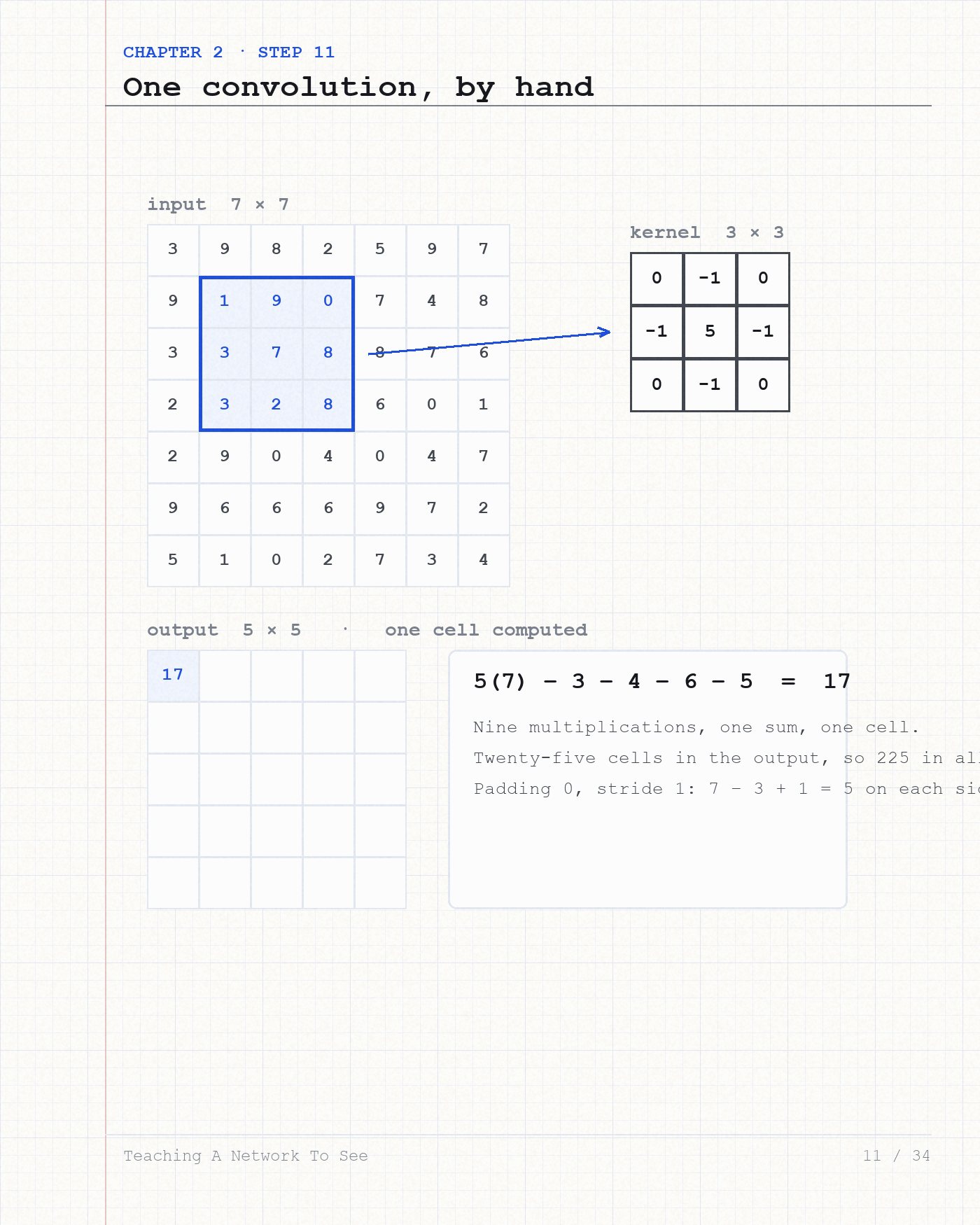
Do it once with real numbers on a 5×5 patch and the whole family collapses into one idea with four settings. After that, reading a model definition is reading, not guessing.
Sample pages
Every step works on a grid small enough to print — the input patch, the filter, the multiplication, and the output value in the right place.
Step 04 · The whole idea
Step 12 · The shape formula
Step 23 · What it learned
34 steps in total
Models trained on images reproduce whatever the training set contained. The last chapter is explicit about what that means before you point one at photographs of people.
What's inside
It introduces one parameter at a time, and only when the previous example has made it necessary — so nothing is a knob you turn without knowing why.
Every worked example fits on a page. You can do the multiplication in the margin and check it against the printed answer.
Stride appears when the output is too big. Padding appears when the edges vanish. Each is motivated before it is named.
Why stacked small filters beat one big one is derived, not asserted — with the receptive field and the parameter count both written out.
What you get
Thirty-four steps across five chapters — the filter, the parameters, the stack, the feature maps and what the model actually learned.
The offer
Teaching A Network To See works one 3×3 filter over one patch by hand, then builds up stride, padding, channels, pooling and depth — thirty-four steps, each on a grid you can check yourself.
Instant digital download. One-time payment of $10.00. Educational material about how neural networks work — not a course, not a certification, and not a promise about employment or salary.
Questions
No. Every worked example is small enough to run on a laptop CPU, and most of them are small enough to do on paper. Training a large model is not what this book is for.
It uses small ones you can follow end to end, then shows you how to read published architectures yourself. Chasing whatever is current this month is not the point.
Only in passing. Attention over patches is the subject of the sequence book; this one is about convolution, which is still what most image pipelines are built from.
No, though it helps. This one re-derives the arithmetic it needs rather than assuming you remember it.
No. It explains how convolutional networks compute. Turning a model into something that runs for other people is a different book in this series.
No — it's a digital guide (PDF), emailed to you right after purchase. Nothing is shipped.
You're protected by a 60-day money-back guarantee. Email us within 60 days for a full refund — no questions asked.
Thirty-four steps that turn convolution from a diagram you have seen into arithmetic you can do.
Secure checkout · Instant download · 60-day guarantee
This is educational material about how neural networks work. It is not a course, a certification, a bootcamp or a career programme, and it makes no promise about employment, salary or professional outcomes of any kind. The code and the worked figures are teaching examples, written for clarity rather than for production: read them, adapt them, and test anything you reuse. Library APIs change often, so the method is what carries over, not the exact call signature. Nothing here is professional, legal or financial advice. Models reproduce the patterns and the biases of the data they are trained on; deploying one that affects people carries responsibilities this book does not cover.