Step 03 · One neuron, by hand
Weights, Sum, Bias, Squash
- Three inputs
- Three weights
- One bias
Start Here
Forty steps from a single multiplication to a network that actually trains. Every step is small enough to work through on paper first, then in nine lines of code — the forward pass, the loss, the gradient, the update, and why each one is shaped the way it is.
Secure checkout · Instant download · 60-day guarantee
Forty worked steps across six chapters — the neuron, the layer, the loss, the gradient, the loop and the first real network.
Sound familiar?
You copied the notebook, the accuracy went up, and nothing inside your head changed. The words are familiar — tensor, gradient, backprop, epoch — but if someone asked you to draw what happens to one number as it moves through one layer, you would stall.
That gap is not a lack of talent and it is not fixed by another framework tutorial. It is fixed by doing the arithmetic once, small enough to hold in your head, until the big version is obviously the same thing repeated.
Sample pages
Every step is laid out the same way: what it computes, what you need, the worked numbers, and the mistake that makes it look like magic instead of arithmetic.
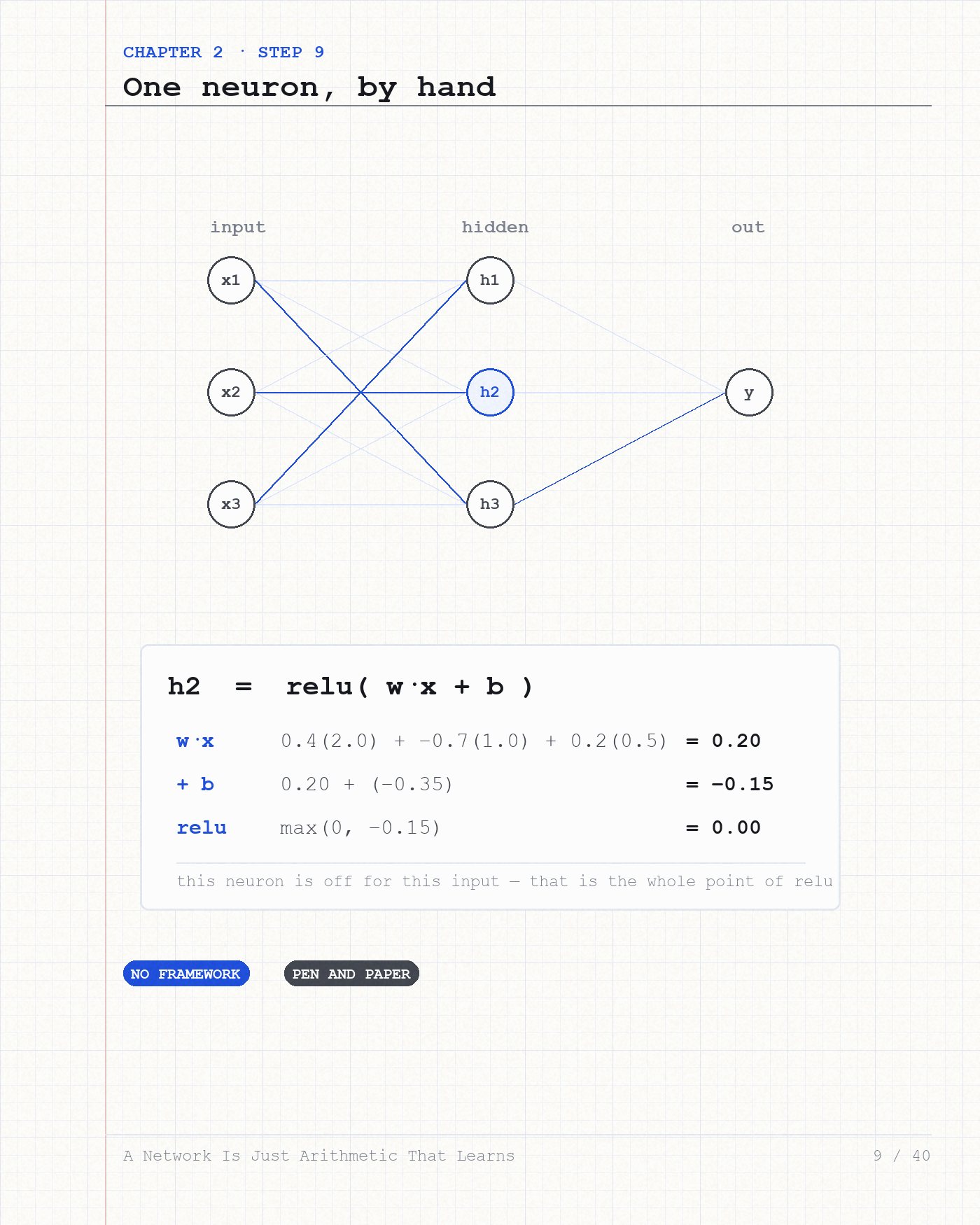
Step 03 · One neuron, by hand
Step 14 · Where the learning is
Step 27 · The whole loop
40 worked steps in total
Every step carries its numbers — the shapes, the values, the derivative — so nothing rests on a phrase you are supposed to already understand.
What's inside
It builds the whole machine from one multiplication, in an order where nothing appears before the thing it depends on.
Every example uses numbers you can carry in your head — three inputs, two layers — so the arithmetic stays visible instead of disappearing into a GPU.
You do each step by hand before you see the code. The code then reads as a transcription of something you already understand.
No step says 'the framework handles this'. Where the framework handles it, the book shows what it is handling.
What you get
Forty worked steps across six chapters — the neuron, the layer, the loss, the gradient, the loop and the first real network.
The offer
A Network Is Just Arithmetic That Learns builds the whole machine from one multiplication — the forward pass, the loss, the gradient and the update — in forty steps small enough to do by hand before you write any code.
Instant digital download. One-time payment of $10.00. Educational material about how neural networks work — not a course, not a certification, and not a promise about employment or salary.
Questions
You need to be comfortable multiplying and adding, and willing to follow a derivative being worked out slowly. The book does not assume you remember calculus — where a derivative is needed, it is derived in front of you with numbers attached.
None, for the first five chapters. Everything is plain Python and NumPy so that nothing is hidden. The last chapter shows the same network in PyTorch so you can see which parts the framework was doing for you.
If you can already derive a gradient by hand and predict every shape in a model definition, yes. If you have trained models that worked without being able to say why, this is the layer underneath the one you have.
No. It is a PDF you work through with a pen. There are no videos, no cohort and no certificate — and nothing here is a qualification.
No book can promise that and you should distrust any that does. This explains how the arithmetic works. What that is worth to an employer depends on far more than one PDF.
No — it's a digital guide (PDF), emailed to you right after purchase. Nothing is shipped.
You're protected by a 60-day money-back guarantee. Email us within 60 days for a full refund — no questions asked.
Forty steps from one multiplication to a network that trains — small enough to follow, complete enough to build on.
Secure checkout · Instant download · 60-day guarantee
This is educational material about how neural networks work. It is not a course, a certification, a bootcamp or a career programme, and it makes no promise about employment, salary or professional outcomes of any kind. The code and the worked figures are teaching examples, written for clarity rather than for production: read them, adapt them, and test anything you reuse. Library APIs change often, so the method is what carries over, not the exact call signature. Nothing here is professional, legal or financial advice. Models reproduce the patterns and the biases of the data they are trained on; deploying one that affects people carries responsibilities this book does not cover.