Failure 06 · The classic
Batch Dimension Missing
- One image
- A model expecting a batch
- unsqueeze(0)
Debugging
Thirty-eight shape failures, written out: the code that caused it, the error as it actually appears, the dimension that is wrong, and the one-line habit that would have caught it before you ran anything.
Secure checkout · Instant download · 60-day guarantee
Thirty-eight failures across five chapters — the batch dimension, convolutions, flattening, broadcasting and losses.
Sound familiar?
You read it three times, change something at random, and it works — or it does not, and you change something else. Either way you learn nothing, because you never found out which dimension was wrong or why it was wrong there.
Shape errors look like framework trivia. They are not. They are the clearest signal you get that your mental model of the data does not match what the code is doing, and they are completely learnable.
Sample pages
Each failure shows the code, the real error text, the dimension at fault, the fix, and the check that prevents it next time.
Failure 06 · The classic
Failure 19 · Silent and worse
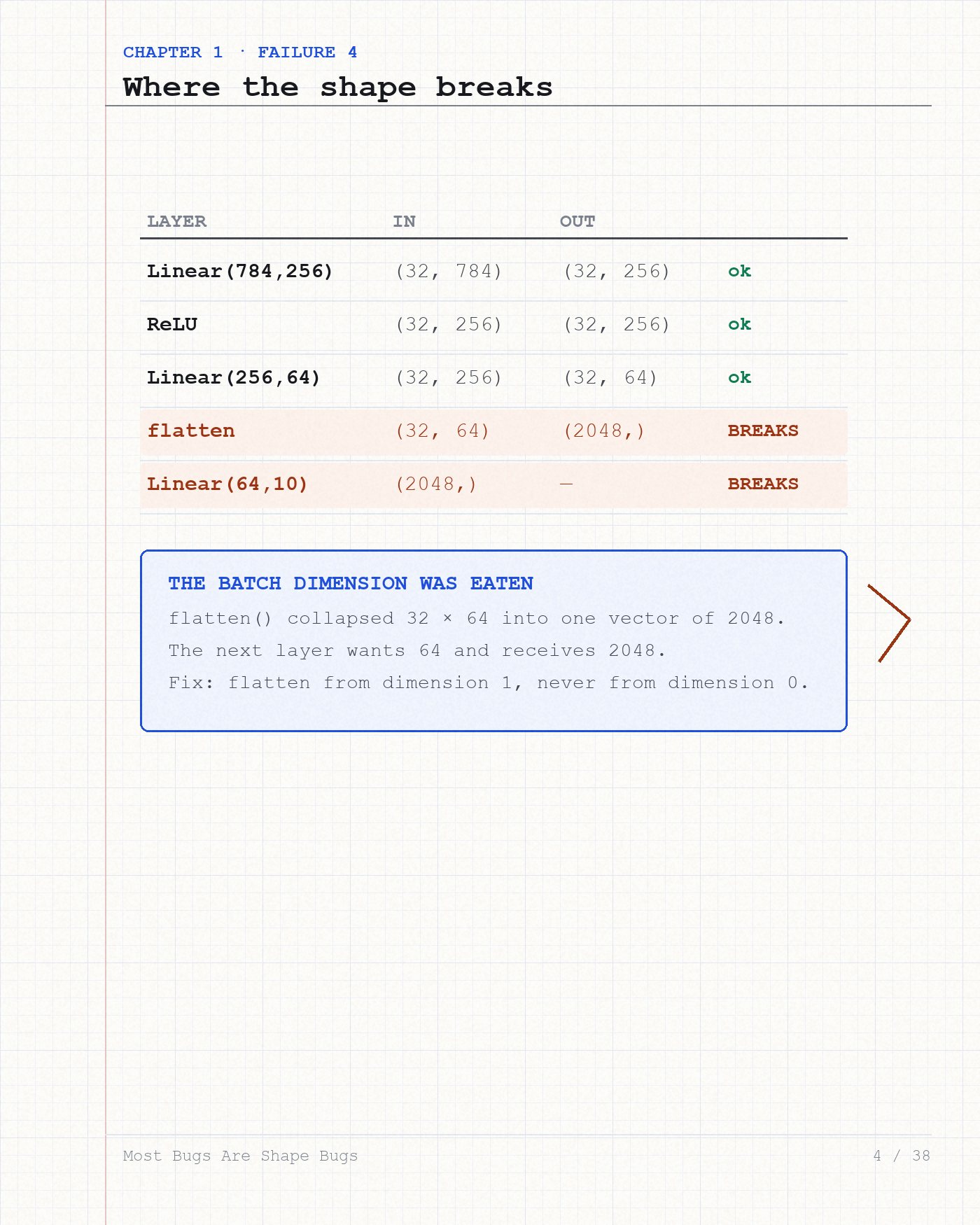
Failure 31 · The flatten
38 shape failures in total
Several entries are silent failures — shapes that broadcast happily and train on nonsense. Those are marked, because they cost the most time.
What's inside
It treats the error message as evidence to be read rather than noise to be dodged, and gives you the arithmetic to predict shapes instead of discovering them.
Every entry quotes the message as it actually appears, so you can match what is on your screen against the page.
Each shape is computed with the formula before it is printed, so you build the habit of knowing rather than checking.
The dangerous ones are not the crashes. They are the shapes that work and mean something else, and those get their own chapter.
What you get
Thirty-eight failures across five chapters — the batch dimension, convolutions, flattening, broadcasting and losses.
The offer
Most Bugs Are Shape Bugs is thirty-eight tensor-shape failures with the code, the real error text, the dimension at fault, the fix, and the check that stops it coming back.
Instant digital download. One-time payment of $10.00. Educational material about how neural networks work — not a course, not a certification, and not a promise about employment or salary.
Questions
Mostly PyTorch, because its messages are the ones people paste into search engines most often. The shape arithmetic is library-independent, and where NumPy or TensorFlow word something differently the book says so.
Printing tells you what happened. This is about predicting what should happen, so that the print either confirms you or tells you something. The difference is the whole book.
No. This one stands alone. It helps if you already know what a layer multiplies, but each failure explains the shapes involved from scratch.
It covers the families: batch, channels, sequence length, flatten, broadcast, loss inputs. Those are where the overwhelming majority of shape errors live, whatever the architecture.
No, it teaches you to debug them. Building is the other books. This is the one you want open at eleven at night.
No — it's a digital guide (PDF), emailed to you right after purchase. Nothing is shipped.
You're protected by a 60-day money-back guarantee. Email us within 60 days for a full refund — no questions asked.
Thirty-eight shape failures with the real error text, the offending dimension and the check that prevents the next one.
Secure checkout · Instant download · 60-day guarantee
This is educational material about how neural networks work. It is not a course, a certification, a bootcamp or a career programme, and it makes no promise about employment, salary or professional outcomes of any kind. The code and the worked figures are teaching examples, written for clarity rather than for production: read them, adapt them, and test anything you reuse. Library APIs change often, so the method is what carries over, not the exact call signature. Nothing here is professional, legal or financial advice. Models reproduce the patterns and the biases of the data they are trained on; deploying one that affects people carries responsibilities this book does not cover.