Step 05 · What is worth keeping
What Early Layers Actually Learned
- A pretrained stack
- A feature map
- Your own images
Transfer
Thirty steps on starting from a network that already learned: what the early layers know that is worth keeping, which ones to freeze, how small your dataset can honestly be, and how to tell adaptation from memorisation.
Secure checkout · Instant download · 60-day guarantee
Thirty steps across five chapters — what is transferable, the freezing decision, the new head, the fine-tuning schedule and the honest evaluation.
Sound familiar?
So you train from scratch, it overfits by epoch two, and the conclusion you draw is that you need more data. Sometimes that is true. Far more often you needed a different starting point, because the early layers of somebody else's network already learned the things your four hundred images cannot teach.
Transfer learning is not a trick. It is a decision with three or four settings — what to freeze, what to replace, how fast to move — and each one has a reason you can state.
Sample pages
Each step names the decision, what it depends on, what it costs, and how to tell whether it worked.
Step 05 · What is worth keeping
Step 11 · The main decision
Step 22 · The honest check
30 steps in total
A borrowed network carries the biases of the data it was trained on into your problem. The book is explicit about that before it is about accuracy.
What's inside
It turns fine-tuning from a recipe you copy into four decisions you make, each with a stated reason and a way to check it.
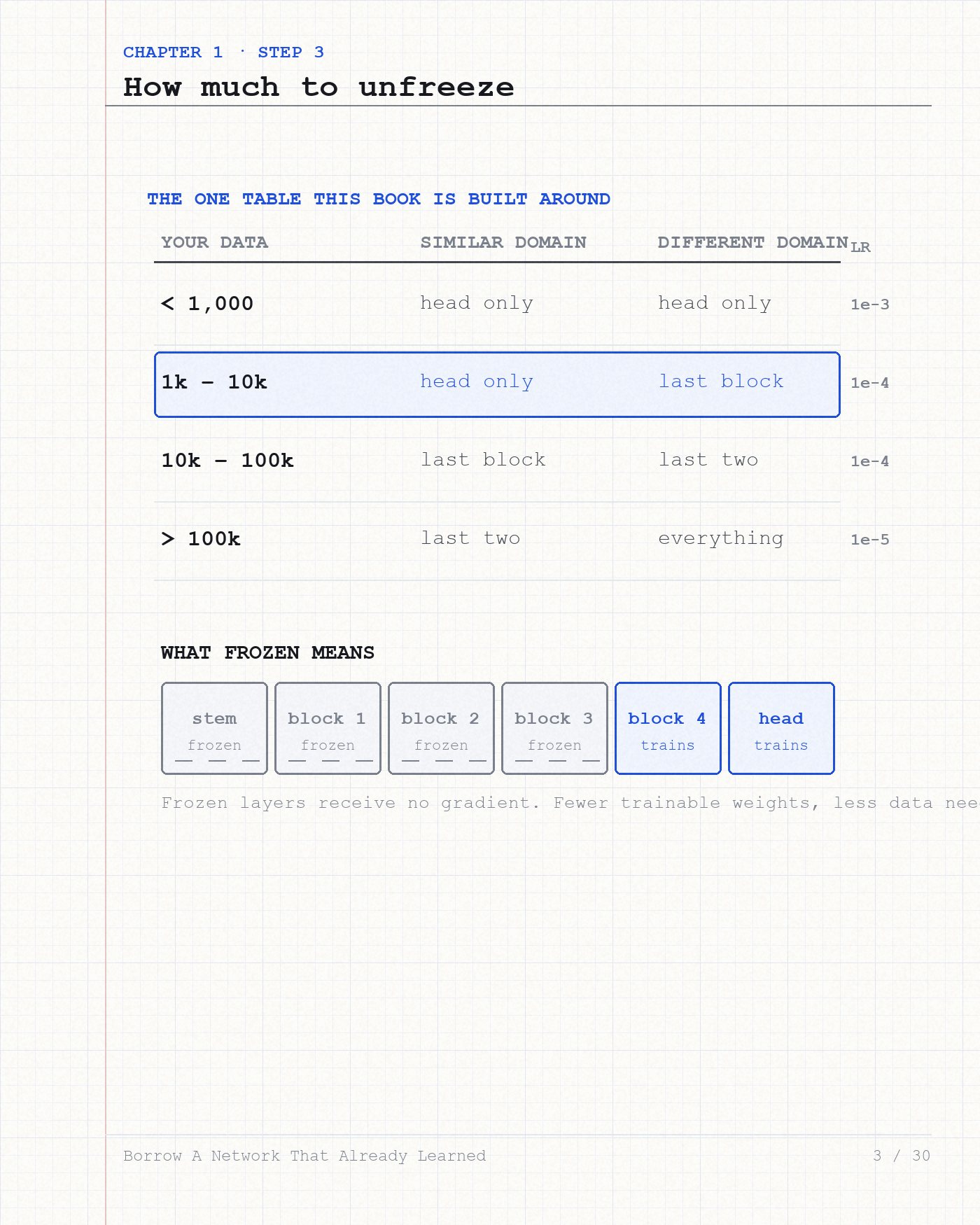
What to freeze depends on two things you can measure. The book gives you the table and the reasoning behind it.
There is a size below which a result stops being evidence. The book says where that is and how to tell you are under it.
Every decision comes with the comparison that tells you whether it helped, rather than a number you hope is good.
What you get
Thirty steps across five chapters — what is transferable, the freezing decision, the new head, the fine-tuning schedule and the honest evaluation.
The offer
Borrow A Network That Already Learned is thirty steps on transfer learning — what to freeze, what to replace, how fast to move, and how to tell whether the result means anything.
Instant digital download. One-time payment of $10.00. Educational material about how neural networks work — not a course, not a certification, and not a promise about employment or salary.
Questions
The book answers this with ranges and the reasoning behind them, and it is honest about the point below which a result stops being evidence rather than becoming a worse result.
The decisions are the same and the book names where they differ. The worked examples are image models because they are small enough to run while you read.
The book explains how to read a model card and what to check before you build on somebody else's weights — including licence and training data.
No, but it helps for the chapter about which early layers are worth keeping.
No, and one chapter is about recognising when it will not — mainly when your domain is far from the source.
No — it's a digital guide (PDF), emailed to you right after purchase. Nothing is shipped.
You're protected by a 60-day money-back guarantee. Email us within 60 days for a full refund — no questions asked.
Thirty steps on what to freeze, what to replace, and how to check the result is real.
Secure checkout · Instant download · 60-day guarantee
This is educational material about how neural networks work. It is not a course, a certification, a bootcamp or a career programme, and it makes no promise about employment, salary or professional outcomes of any kind. The code and the worked figures are teaching examples, written for clarity rather than for production: read them, adapt them, and test anything you reuse. Library APIs change often, so the method is what carries over, not the exact call signature. Nothing here is professional, legal or financial advice. Models reproduce the patterns and the biases of the data they are trained on; deploying one that affects people carries responsibilities this book does not cover.