Step 04 · The first separation
Training Code vs Inference Path
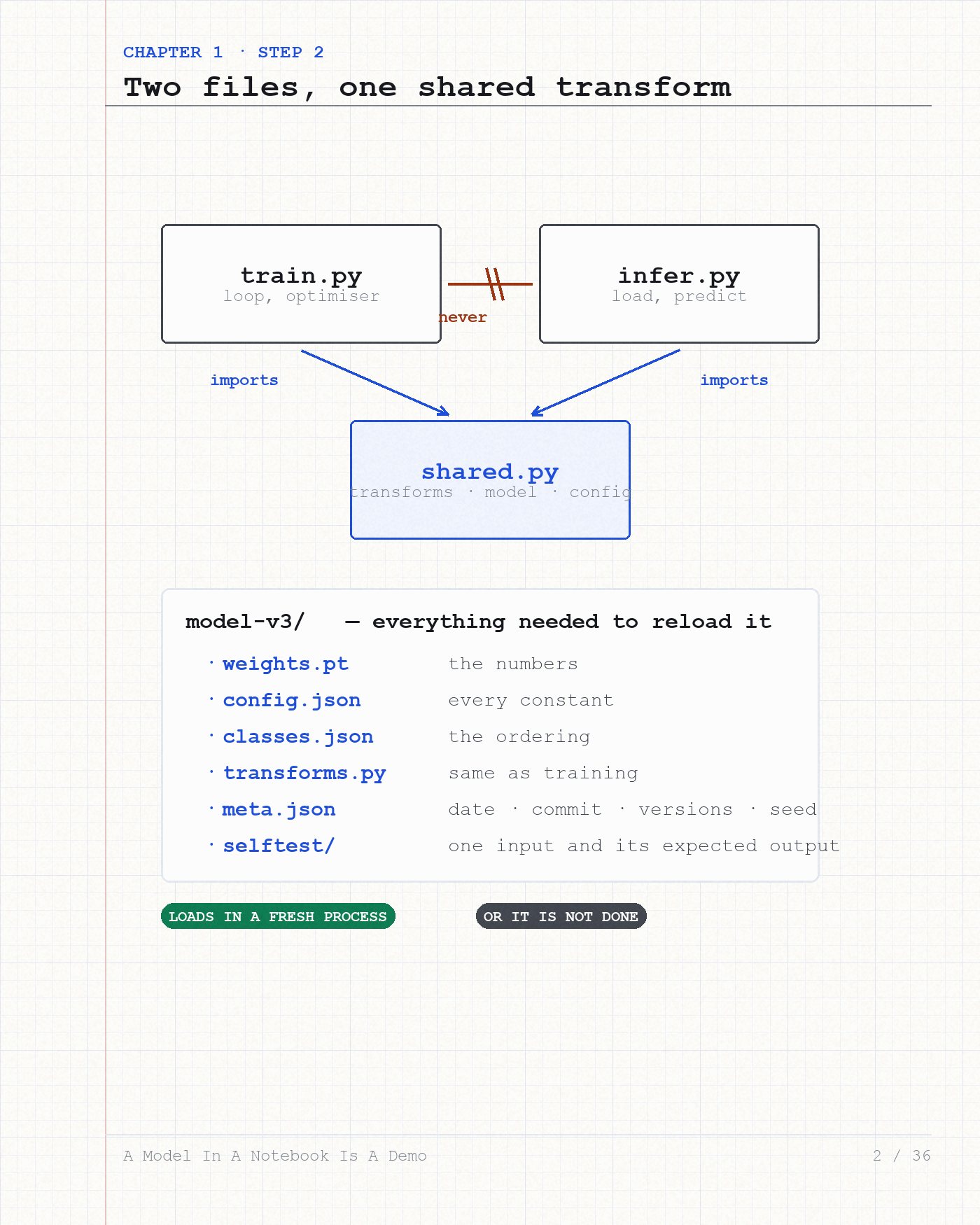
- Two files
- One shared transform
- No notebook
Shipping
Thirty-six steps from a notebook to something that runs for someone else: saving weights so they load, separating training code from the inference path, measuring latency honestly, and noticing the day the inputs quietly change.
Secure checkout · Instant download · 60-day guarantee
Thirty-six steps across five chapters — separation, saving, the inference path, measurement and what happens after a week.
Sound familiar?
The preprocessing is spread across four cells, two of which you edited after training. The weights are in a file called final_v2_real.pt. Nobody, including you next month, can reproduce the number you reported.
Getting out of the notebook is not about Docker or Kubernetes. It is about separating the thing that trains from the thing that predicts, pinning what they share, and being able to say what the model will do when the input is slightly wrong.
Sample pages
Each step names what it makes reproducible, what it costs in time, and what it prevents when the thing is running without you watching.
Step 04 · The first separation
Step 13 · So it loads next year
Step 27 · The thing people forget
36 steps in total
A model that runs for other people can affect them. One chapter is about what to log, what to be able to explain, and when a human has to stay in the loop.
What's inside
It is about the handful of separations and records that make a model survive contact with other people — not about any particular deployment stack.
Nothing here depends on a cloud provider. The same separations apply whether it runs in a container, a cron job or a laptop.
Most shipping problems are really reproducibility problems wearing a different hat. That is where the book starts.
The failure that matters is not a crash. It is correct-looking output on inputs the model has never really seen.
What you get
Thirty-six steps across five chapters — separation, saving, the inference path, measurement and what happens after a week.
The offer
A Model In A Notebook Is A Demo is thirty-six steps from a notebook to something that runs for other people — the separations, the records, the measurements and the checks that keep it working after you stop watching.
Instant digital download. One-time payment of $10.00. Educational material about how neural networks work — not a course, not a certification, and not a promise about employment or salary.
Questions
No. The book is deliberately stack-independent — the separations it teaches apply whether the thing ends up in a container, a scheduled job or a script on one machine.
It is the part of it that matters at small scale, and it stops before the tooling. If you have one model and a handful of users, this is the right size.
No. High-throughput serving is an infrastructure subject and pretending otherwise would make this book worse.
No. This one assumes you have a trained model and takes it from there.
It will make it reproducible, measurable and observable, which is most of what that phrase means. What your particular context requires is yours to judge.
No — it's a digital guide (PDF), emailed to you right after purchase. Nothing is shipped.
You're protected by a 60-day money-back guarantee. Email us within 60 days for a full refund — no questions asked.
Thirty-six steps of separation, saving, measurement and the checks that catch a quiet failure.
Secure checkout · Instant download · 60-day guarantee
This is educational material about how neural networks work. It is not a course, a certification, a bootcamp or a career programme, and it makes no promise about employment, salary or professional outcomes of any kind. The code and the worked figures are teaching examples, written for clarity rather than for production: read them, adapt them, and test anything you reuse. Library APIs change often, so the method is what carries over, not the exact call signature. Nothing here is professional, legal or financial advice. Models reproduce the patterns and the biases of the data they are trained on; deploying one that affects people carries responsibilities this book does not cover.